10th Conference on Robot Learning (CoRL 2026)
Anonymous Author(s) · Double-Blind Review
Hamilton-Jacobi (HJ) reachability provides a principled framework for synthesizing safety certificates and robust controllers for safety-critical robotic systems. However, applying reachability analysis to high-dimensional nonlinear systems remains challenging: classical grid-based solvers suffer from the curse of dimensionality, continuous-time neural solvers require accurate spatial value gradients, and RL-based approaches suffer from weak boundary anchoring.
We propose a discrete-time neural reachability framework for control-disturbance-affine systems that learns backward reachable tubes (BRTs) and BRATs through Bellman-Isaacs value propagation. Our key idea: exploit the bang-bang structure of optimal safety interventions to construct teacher actions from gradient-free value probes, converting adversarial actor learning into supervised policy learning.
To stabilize long-horizon value propagation we train the value function backward from the terminal boundary using a windowed temporal curriculum. Across benchmarks up to 80 dimensions our method improves stability over existing solvers. We further scale to F1-tenth racing with 16,000+ dimensional egocentric inputs, achieving zero-shot sim-to-real transfer.
Bang-bang probes replace ∇ₓV. No SIREN/PINN optimization noise, no gradient instability in high dimensions.
128×128 BEV occupancy grids fed directly — no handcrafted feature engineering required.
Windowed backward curriculum prevents bootstrap drift that collapses RL baselines at high dimensions.
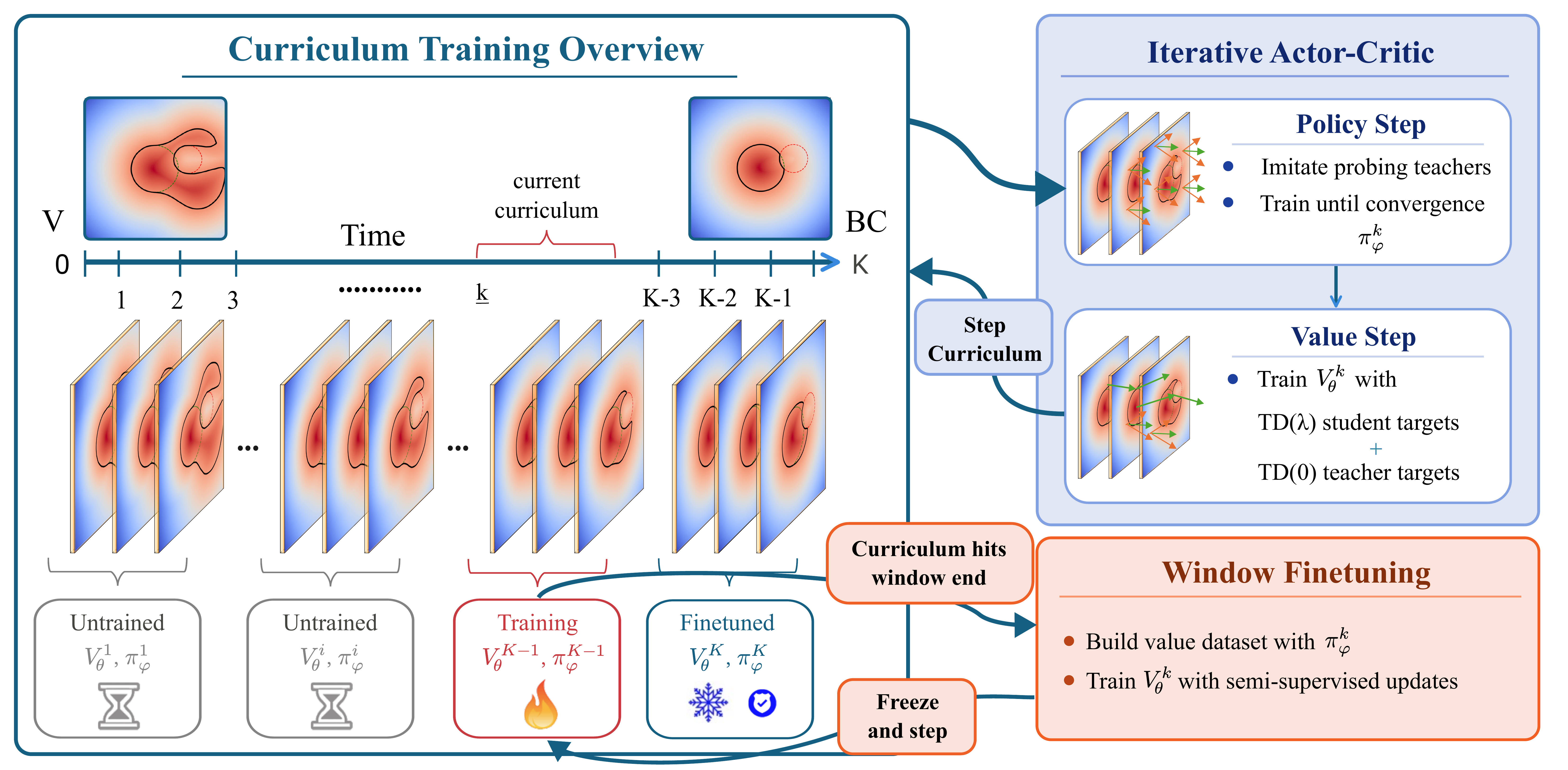
A single monolithic network causes representational overload for long-horizon problems with non-smooth reachable-set boundaries. We partition horizon K into windows — each with independent weights. Later-time frozen windows become boundary conditions for earlier windows.
Unlike PINNs, we infer optimal safety and disturbance actions via discrete value comparisons of forward-simulated next states — no analytic ∇ₓV needed. Only 2(n_u+n_d) evaluations per state convert unstable minimax RL into supervised regression.
50/50 blend of one-step teacher targets (Bellman-Isaacs anchor) and multi-step student rollout targets prevents compounding suboptimality. Time indices near the current boundary are oversampled to lock boundary-condition compliance.
Before freezing each window, a finetuning phase calibrates the value network against empirical rollout targets under the current student policies. An asymmetric false-positive penalty suppresses states falsely predicted safe.
Left: Curriculum propagates backward from boundary condition (BC) at k=K. Each window trains, finetunes, then freezes as BC for the preceding window. Right: Within each step, the policy imitates bang-bang teacher probes and the value is updated with mixed TD(0)/TD(λ) targets.
Toggle the HJ safety filter on/off to see the backward reachable tube in action. Click inside the canvas to re-anchor the initial state.
Active — prevents state from breaching BRT boundary.
The crimson BRT overlay marks states where worst-case disturbances exceed control authority — failure is mathematically inevitable without intervention.
20K samples · 5 random seeds · FPR = dangerous over-optimism ↓ · FNR = over-conservatism ↓ · Succ ↑
| Method | FPR% ↓ | FNR% ↓ | Succ% ↑ | Time(h) ↓ |
|---|---|---|---|---|
| Ours | 100† ± 0.00 | 0.00 ± 0.00 | 99.65 ± 0.31 | 4.0 |
| DeepReachMPC | 0.00 ± 0.00 | 100.0 ± 0.00 | 2.50 ± 0.90 | 5.0 |
| RL Baseline | 0.00 ± 0.00 | 93.40 ± 0.70 | 3.70 ± 0.72 | 5.5 |
† All evaluated initial states are inherently safe; 100% FPR reflects long-horizon (T=8s) policy execution errors, not value function over-optimism. The value correctly identifies states as safe — see §4.
Side-by-side: HJ safety filter vs unfiltered nominal controller.
10 laps · zero collisions · avg 1.07 m/s on unseen physical track. All compute runs offboard over WiFi with ~50 ms round-trip.
✓ Filtered — 0 collisionsUnfiltered MPPI tracks racing line at max speed — 3 collisions within the very first lap on the physical track.
✗ Unfiltered — 3 crashes lap 1BRT safety filter for high-speed autonomous racing (max 10 m/s). Model ingests a 128×128 egocentric BEV image + 5D proprioceptive state + time (16,390D total) + disturbance scale. At test time the learned value function acts as a Discrete-Time Control Barrier Function (DCBF) filter over a nominal MPPI controller.
Avg speed 9.25 m/s (in-distribution) and 9.17 m/s (OOD tracks). Zero-shot to 3 held-out tracks under disturbance scale s_d = 0.1.
Unfiltered MPPI on in-distribution and OOD tracks respectively. Failures at high slip angles near sharp turns. LiDAR insufficient — BEV is essential.
Avg 1.07 m/s at hardware limit (1.5 m/s). s_d = 0.2 absorbs ~50 ms WiFi latency + sim-to-real gap on a previously unseen track.
Nominal MPPI blindly tracks racing line at max speed, colliding within its very first lap on the physical track.
@inproceedings{anonymous2026gradfreereachability,
title = {Gradient-Free Neural Hamilton-Jacobi Reachability
for Scalable Safety-Critical Control},
author = {Anonymous Author(s)},
booktitle = {10th Conference on Robot Learning (CoRL)},
year = {2026},
note = {Submitted. Anonymous review version.}
}